Thursday, May 24, 2012

What if Hayek died early and Keynes lived very long?

Hayek and Keynes were personal friends but intellectual rivals. Keynes was a brilliant, unconventional Englishman. Hayek was an outspoken émigré from ravaged Austria. Their economic views have changed, shaped and dictated the way we understand economics and economy, state's role in the economy and state's economic policies, once and for all. (Keynes' name is frequently mispronounced; so is mine too. Do you know how to pronounce my name? :-))

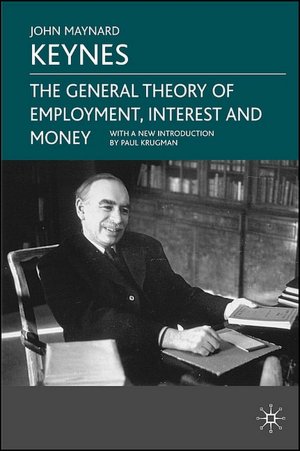
Adam Smith is a father of modern economics, but it is Keynes who invented macroeconomics. John Maynard Keynes published his The General Theory (we can also read the whole book at the Google-books), a brilliant analysis of how to fight the Depression, In 1936. That book made him the most influential economist of the age. Keynes advices governments that it was possible to manage their economies. (Nobel Laurate and also the most famous Keynesian, Paul Krugman wrote an introduction to Keynes' General Theory. I will write a short note about it later. It is an important paper). 

Image from http://www.betterworldbooks.com/the-general-theory-of-employment-interest-and-money-id-9650060251.aspx

Curiously, Hayek did not write any reviews or any counter argument on The General Theory. Bruce Caldwell, Professor at Economics Department of Bryan School, North Carolina University, wrote a (free down-loadable) paper entitled “Why didn’t Hayek review Keynes’s General Theory?” in History of Political Economy, 30:4, 1998. I will also write a short note of it later. But we have to remember that working slowing and taking time is Hayek's nature; had he died young I believe he would definitely not get a Nobel prize (it takes very long time to get his view and theory understood, accepted and appreciated). If Keynes lived long, I believe he will definitely get a Nobel prize, probably not only one, but two; one for his economic theory and another one for his literary works (like Winston Churchill).

He invented concepts we take for granted today, like gross domestic product (GDP), the level of unemployment, the rate of inflation, all to do with general features of the economy. Moreover, he also initiated, organised and established the IMF and the World Bank. Keynes did not have long to live. Ill and overworked, his health gave way. When he died in 1946 at 62 (in fact he was not so young, according to the standard of our developing economies), Keynes was raised to sainthood.

Oh, Great Keynes, your contribution to the humanity is invaluable, much more greater than the values of all Kings, Queens, Princes, Princesses, all royal families combined together. What did these so-called majesty do for the humanity; they just colonized, bullied, attacked, annexed invaded, stole, looted almost all nations around the world, and exploited, tortured, imprisoned and assassinated countless national heroes, great leaders and freedom fighters of many nations. (I know my discussion was digressed now.)


Look at how they were behaving like children, they were so cheerful and carefree. I like their hats.
Image from http://tek.bke.hu/keynes120/foto/keynes/keynes_russell.jpg
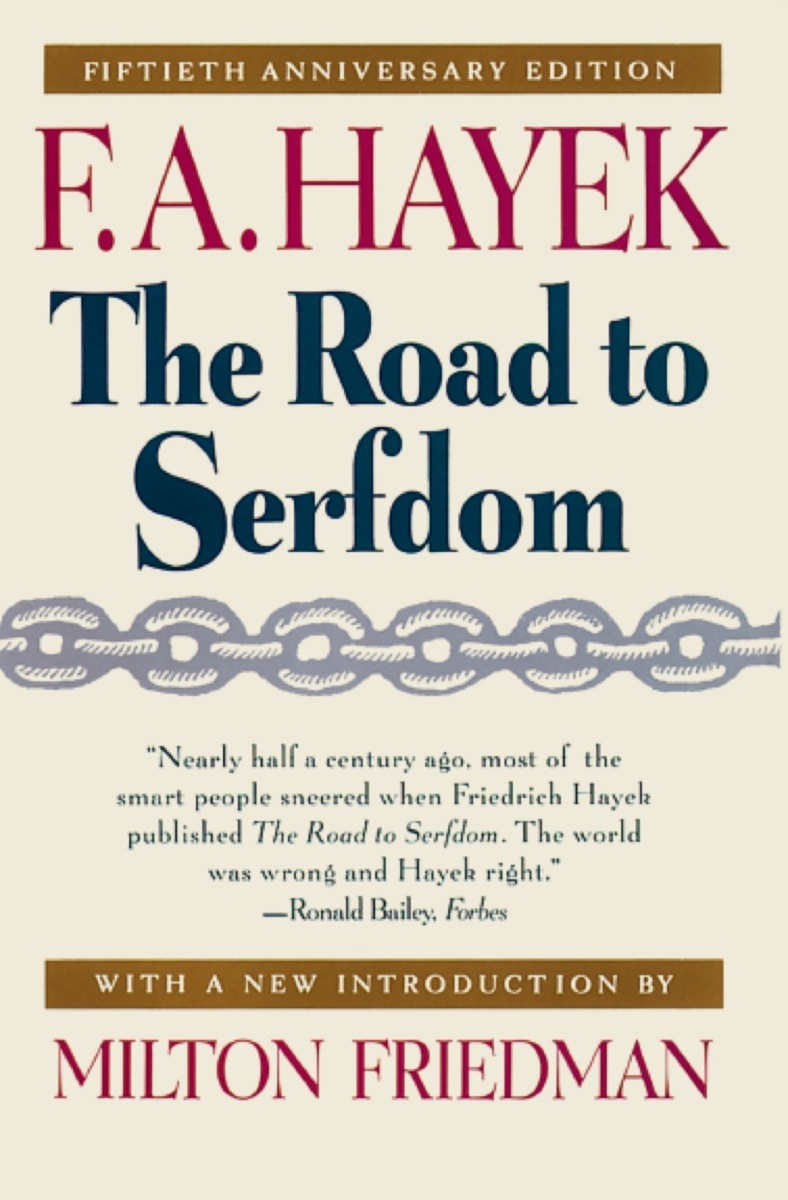
On the other hand, Hayek thought government interference in the economy was a threat to freedom. Hayek always rejected macroeconomics. He rejected any government intervention during the Great Depression itself. He feared that Keynes's brave new world was a big step in the wrong direction. In 1944 he published The Road to Serfdom that is about Hayek's ideas of freedom and competitive enterprise and opposition to any state's planning and controls in the economy. (There is also a (free downloable) condensed version of it appeared in the Reader’s Digest April 1945 edition, an illustrated version of it is also included at that book.) His ideas were at that time shunned by the academic world. Most of the university departments disliked him, and economists treated him as an outsider. No universities wanted to hire him, except the Chicago School.

Image from http://www.bibliovault.org/thumbs/978-0-226-32061-8-frontcover.jpg
He won the Nobel Prize for economics in 1974. Unlike Keynes, Hayek lived a very long life, and died in 1992 at the age of 92. (Look at the interesting numbers; 1992, at the age of 92.)


Look at how serious Hayek was, he did not smile, and was so thoughful. I don't like that class, it's too conservative; the class had only two women (perhaps just one woman).
Image from http://thinkmarkets.files.wordpress.com/2011/05/hayek1.jpg
(I will talk about them later; these two are so brilliants, two of the most important persons in the economics, and also the most important persons who influence my intellectual life. There are too much to talk about these two monsters; we can write series of books about them.)

Myo
(17 June 2011, Friday. 6:31 p.m.)
Note: I haven't written any posts these days, because I have been too busy with my study. This one is an old one that I have written long time ago. I am going to give references, to make it more academic and also include some photos of Keynes and Hayek, with a couple of their books. Both of them are so important for us.

Sunday, May 6, 2012

On Researchal Significancy


Have you ever got a thought, at least fortuitously, that one day findings from your research, which is boring, demanding, exacting that you have been doing for ages, all alone, through being broke so often, unnoticed and unimpressed by people around you perhaps those include your spouse or your girl-friend or boy-friend, even your parents, brothers or sisters, or your comrades, or your pastors or monks or boring Pope, or your government, your opposition, will, forever, for once and for all, change the way we understand about our lives or the nature, or improve our living standards exponentially or the way our government perform its task that actually serve our interest, or provide the better ways to treat or cure the diseases? (I know, I know, my sentence is too long. But remember Keynes’ General Theory is also badly organised and difficult to read. In fact, according to one of his greatest admirers, Paul Samuelson, who was also an author of very famous economic text book, Keynes' General Theory is "badly written, poorly organised .... it is arrogant, bad-tempered, polemical and not overly generous in its acknowledgements. It abounds in mare's nests and confusions". However, he continues, "in short, it is a work of genius" (cited in Moggridge, 1992, cited again in Strathern, 2002: 281. I am going to write a lot of posts on Keynes.).

Image from Barnes & Noble,

Trust me, never, ever, forever underestimate the significant of your research that you love dearly, you are so passionate about, you live with it, sleep with it, and have been giving up everything just for it.

It might not happen suddenly, but it will really have invaluable impact in one way or another as long as you believe in yourselves and in what you are researching correctly, professionally, diligently.
With that belief, single-mindedness, and gigantic crazy dream, with a little bit of arroganceness, I stick to my research and my writings, no matter what.

Let’s see one example to support my argument.

It was happened about 80 years ago: to be precise, it was on February 13, 1929.

The place was at St. Mary’s Hospital in London.

It was just a normal research paper reading at the Medical Research Club.

The paper was read by (oh!, no, I will not tell the name of the researcher, but I will do it later.)

The audience at the club was apathetic. No one showed any enthusiasm for the paper.  As Leedy and Ormrod (2001: 43) rightly observe, “great research has frequently been presented to those who are imaginatively both blind and deaf.” (Now, I understand why research grant organizations are not so keen about my research. They are just imaginatively blind and deaf. All of them will be greatly regretful for being uninterested to grant research grants for my research project.)

Although his colleague and audience at the club were indifferent, unimpressed, and apathetic, he knew the value of what he had done, what he had found from his research.  He knew how significant his research outcome really is.

It was actually one of the greatest moments in 20th-century medical research (Leedy & Ormrod, 2001: 43).

Fifteen years later from that day the researcher read his paper to imaginatively blind and deaf audience, he was awarded the Nobel Prize in medicine, together with two other researchers. It was in 1945.

His name is Alexander Fleming, or Dr Alexander Fleming, or Sir Alexander Fleming.

Fleming (centre) receiving the Nobel prize from King Gustaf V of Sweden (right) in 1945.
Image from the Wikimedia Commons http://en.wikipedia.org/wiki/File:Nobelpristagare_Fleming_Midi.jpg

The paper he read at the club was about his research on penicillin. It was in fact presentation of one of the most significant research reports of the early 20th century.


Fleming was named by Time magazine, in 1999, as one of the 100 Most Important People of the 20th Century for his discovery of penicillin, by stating that “it was a discovery that would change the course of history. … the most efficacious life-saving drug in the world, penicillin would alter forever the treatment of bacterial infections” (Time, 29 March 1999).

The procedures of great research (Nobel research, in my term) are exactly the same as those of what we, students, follow in doing our dissertation, thesis, research report. “All research begins with a problem, an observation, a question. Curiosity is the germinal seed.
     Hypotheses are formulated.
     Data are gathered.
     Conclusions are reached” (Leedy & Ormrod, 2001: 44).

(I did try to paraphrase, but the original composition is so beautiful and so perfect. So I gave up. It’s better to quote directly, faithfully :-)


(I am going to tell about Charles Goodyear soon, who lived his whole life, and gave up everything just for a single purpose.)


References

Moggridge, D. (1992) Maynard Keynes: An Economist’s Biography. London: Routledge. According to Strathern (2002), it is the best single-volume biography of Keynes’ life, times and ideas.
Leedy, P. D. and Ormrod, J. E. (2001) Practical Research: Planning and Design (7th Ed). Upper Saddle River (New Jersey): Merrill Prentice Hall.
Strathern, P. (2002) Dr Strangelove’s Game: A Brief History of Economic Genius. London: Penguin.

Note: The previous title was given as “Significance of Research”, but I felt that it was so boring and then tried to be creative and got that new title; it sounds like so Latin. I am also so pleased with my coincency: I again got that new term deriving from ‘coin’.

Friday, May 4, 2012

Harold Dwight Lasswell

 
Harold Dwight Lasswell (1902-1978)

Various intellectual methodological approaches such as interviewing techniques, content analysis, para-experimental techniques, and statistical measurement were originated, developed and applied by Lasswell long before these methodologies become standards, and famous across a variety of intellectual traditions that all of us, students and researchers are taken for granted.

Harold Dwight Lasswell is seen by many as the father of policy sciences. He was a prolific author, and authored over 30 books and 250 articles. "He was the most original and productive political scientist of his time" (Almond, 1987: 249).

Marvlck (1980: 219) states that “throughout the half century of his career, Harold D. Lasswell remained an intellectual iconoclast.” In a biographical memorial written by Gabriel Almond at the time of Lasswell's death (1978), Lasswell "ranked among the half dozen creative innovators in the social sciences in the twentieth century." (Almond, 1987: 249).

It was Lasswell who coined the term “the policy sciences,” (Farr, Hacker & Kazee, 2006: 1) now this phrase is all over the world of academic and research. In his book, Politics: Who Gets What, When, How, Lasswell (1938) states that politics is the resolution of conflict over “who gets what, when, how?”

Image from Amazon 
http://www.amazon.com/gp/product/images/1258035707/ref=dp_image_text_0/177-4538592-9248563?ie=UTF8&n=283155&s=books

According to Lasswell (1942), the liberal, democratic state did not succeed in harmonizing professed ideal and effective policy, partly because in the policy process, the democratic elements in the ideal were left undeveloped. Some shortcomings of liberal, democratic states have been failures of policy and intelligence. The paper stresses the important and critical role of intelligence (which has been neglected) in the policy process and analysis.

Marvlck (1980: 229) beautifully states that “Lasswell's approach was substantive; his concerns were humane; his influence has been cumulative. In his lifetime, he did a great deal. He did it all in a style that was inimitable and memorable”.

Lasswell (1971: 3) affirmed of his intellectual credo as follow:
Surely the qualified scientist is a participant observer of events who tries to see things as they are. He demands of himself, and of anyone who purports to be a scientist, that he suppresses no relevant fact and that he holds all explanations tentatively, and therefore open to revision if more adequate explanations are proposed . . . . Anyone worthy of the name of scientist must be able to struggle with considerable success against jealousy, envy, bigotry, and any other attitude that interferes with clarity of perception and judgment.


According to Encyclopedia of World Biography (2004), there is no biographical study of Lasswell. Perhaps one of us should do it.

(There are many things to talk about Lasswell, I will continue it later. I have to do other things :-))


References

Almond, G. A. (1987) Harold Dwight Lasswell (1902-1978):  A Biographical Memoir. Washington D.C.: National Academy of Sciences. Retrieved May 4, 2012, from http://books.nap.edu/html/biomems/hlasswell.pdf
Encyclopedia of World Biography (2004), Harold Dwight Lasswell. Retrieved May 04, 2012 from http://www.encyclopedia.com/doc/1G2-3404703735.html
Farr, J. S., Hacker, J. S. & Kazee, N. (2006) The Policy Scientist of Democracy: The Discipline of Harold D. Lasswell. In American Political Science Review, Vol. 100, No. 4 November. 2006. Retrieved May 4, 2012, from http://www2.lse.ac.uk/CPNSS/events/Abstracts/HIstoryofPoswarScience/Farr%20et%20al%20final%20proof.pdf
Lasswell, H. D. (1938) Politics: Who Gets What, When, How. New York: McGraw-Hill.
Lasswell, H. D. (1942) The Relation of Ideological Intelligence to Public Policy. In Ethics, Vol. 53, No. 1, Oct., 1942. pp. 25-34. Retrieved March 10, 2012, from http://www.jstor.org/stable/2988844.
Lasswell, Harold D. (1971). A Pre-View of the Policy Sciences. New York: American Elsevier.
Marvlck, D. (1980) The Work of Harold D. Lasswell: His Approach, Concerns, and Influence. In Political Behavior. Vol. 2, No. 3, 1980. New York: Agathon Press (pp. 219-229). Retrieved May 4, 2012, from www.springerlink.com/index/x0424l58h207167m.pdf

Thursday, April 26, 2012

Grounded Theory

“Whenever possible, stay away from it”
“It is too complicated, and difficult to handle and manage.”


Yesterday, I attended a PhD short proposal defence (the very first one. In our school we have to do at least three defences in the course of doctoral project. Some students have to do five or six defences.).

It was so hard for the student (he was clearly disappointed and discouraged, although I tried to encourage, motivate and cheer him up by saying that it is supposed to be hard, challenging and so difficult, and he was not alone who is under severe, deadly, attacks at the defence panel. At defence panel, every (at least almost every) student has the same terrible, intellectually humiliating, experience.  It is, in fact, the panle members' job to question, criticise, interrogate and make sure students know what they are going to do in their long research project. But unfortunately and unintentionally they usually also intimidate us. In fact all of panel member as well as professors, lectures are our intellectual and academic parents.

Although most of the defence panel members were kind, as always they are, and considerate, (however, they still did not restrain asking several hard questions and made couple of cruel, but at the same time very helpful comments) one panel member, who is primarily responsible for research methodology, was so tough and a bit (or may be very) aggressive. I was allowed to ask questions there but I decided not to ask any questions.

One of the lessons that I have learnt at the defence is about grounded theory, so well-known among research students but most of us do not really know about it. In his proposal, the student said he is going to use “grounded theory” as his research methodology.

After the student’s 20 minutes presentation, one panel member, who is mainly responsible for the quantitative research methodology and statistical issues, started asking about sampling size of the study briefly, and then he said then your research is not a quantitative research because your sample size is too small (the student said his study is going to use mixed methods, i.e, using qualitative and quantitative methods). After that he asked about “grounded theory”.  He said it is great if you can handle and successfully apply the grounded theory but in his view, grounded theory approach needs to be structured extremely well. The one panel member quickly interrupted: “my best advice to students is “stay away from the grounded theory whenever possible. It is too difficult and most students cannot manage it.”  The another panel member entered the discussion: “Everybody told me not to do grounded theory, but I did not listen when I did my PhD, and it gave me a lot of trouble, stress, hard works along my PhD project, but I eventually completed my PhD with grounded theory. It is not impossible, it is just too complicated and you need to plan and structure your research methodology very well if you are going to use the grounded theory.”

After the defence, I left the room with deep insatiable intellectual curiosity about that monster called "grounded theory". My research does not use grounded theory; I use “case study” methodology, so I do not really need to bother myself and to spend my time with it but I still cannot control myself to study about it. Okay, then, what really is the grounded theory? The following is a few very short notes on it. I hope my notes will be some helpful for students, who are like me, love studying, learning and reading.


Grounded Theory

Anselm L. Strauss, co-founder of Grounded Theory.
Image from Amazon, http://www.amazon.de/Anselm-Strauss-Klassiker-Wissenssoziologie-Str%C3%BCbing/dp/3896695487

Barney G. Glaser, co-founder of the grounded theory, at his 75th birthday with wife Carolyn. Photo: Hans Thulesius. Image from Wikipedia, http://en.wikipedia.org/wiki/File:Glasr75.jpg. (This photo has been released into the public domain by its author, Thulesius.)
First of all, grounded theory is a research method originated, developed, introduced and popularised by Barney G Glaser and Anselm L. Strauss in their book, The Discovery of Grounded Theory. According to Glaser and Strauss (1967: 2). It is a "systematic, qualitative process used to generate a theory that explains, at a broad conceptual level, a process, an action, or interaction about a substantive topic" (Creswell, 2002: 439).

The aim of the research using grounded theory is, according to Yee (2001) “to know what is going on, to look at areas that have either never been studied before or those that are inundated with disparate theories’.

The Discovery of Grounded Theory: Strategies for Qualitative Research by Glaser and Strauss(1967). Image from Amazon, http://www.amazon.com/Barney-Glaser-Anselm-Strauss-Qualitative/dp/B004RPNIU8

In their book, The Discovery of Grounded Theory: Strategies for Qualitative Research (1967), Glaser and Strauss (1967) stated that most research in their time (around 1967) was designed just to verify existing theories, but not to generate new ones. Instead of exploring new areas that were not covered by existing theories, current (around 1967) researchers were just eeking out small pieces of knowledge from existing “grand theories”.

Grounded Theory takes a research approach, which is contrary to most of the more conventional research models (Figure 1). Unlike conventional research methods, in grounded theory approach, data collection, coding and analysis are done immediately, concurrently, and throughout. The process is not impeded by the development of research problems, theoretical understanding or literature review (Jones, Kriflik & Zanko, 2005: 6).


Figure 1. Comparison of Conventional Research Methods to Grounded Theory (Jones, 2005, cited inJones, Kriflik & Zanko, 2005: 7).
  

 I will talk more about it later. I have to do some urgent works now :-)


Reference


Creswell, J. W. (2002). Educational research: Planning, conducting, and evaluating quantitative and qualitative research. New Jersey: Merrill Prentice Hall.
Glaser, B. G. & Strauss, A. L. (1967) The Discovery of Grounded Theory: Strategies for Qualitative Research. Chicago, Aldine Publishing Company.  
Jones, M. L., Kriflik, G., and Zanko, M. (2005) Grounded Theory: A theoretical and practical application in the Australian Film Industry. Retrieved April 26, 2012, from http://ro.uow.edu.au/cgi/viewcontent.cgi?article=1090&context=commpapers
Yee, B. (2001). Enhancing Security: a Grounded Theory of Chinese Survival in New Zealand. Education Department, University of Canterbury. Retrieved April 26, 2012, from http://ir.canterbury.ac.nz/handle/10092/1771

Friday, April 20, 2012

Four roots of the service delivery problem

Image from Bazaar International, http://www.bazaarint.com/

The World Bank (2003), in its 2004 World Development Report, argues that there are four root causes for the service delivery problem.


Misallocating Resources

The first cause is about resource allocation or budgeting. The service delivery becomes weak and poor when the government misallocates resources (or budget), i.e., spending on the ‘wrong’ goods or the ‘wrong’ people (not to the actual service providers). Without resources, the necessary service could not be delivered. It is a fault of budging or resource allocation system.


Expenditure ‘Leakages’

The second cause is about expenditure. Even if the resources (budget) are allocated correctly, the resources (money) do not reach its ultimate destination because of expenditure ‘leakages’. It is a fault of expenditure tracking system.


Weak Incentive

The third cause is about incentive. Even when the resources (money) reach the service providers, the service delivery may still be weak because the service providers do not deliver the service. The reason might be there is no or weak incentive for the service provider to deliver the service. It is a fault of accountability and monitoring system.


Demand Side Failure

The last one is called “demand side failure”, i.e., people (community members) may not be aware of their rights and services they are entitled to and may not avail of the services provided to them. It simply means that people do not know what they can get from the government as their rights. It is a fault of public awareness and participation system.


Reference

World Bank (2003) World Development Report 2004. Making Services Work for Poor People. Washington D.C.: World Bank. Retrieved February 14, 2012, from http://www-wds.worldbank.org/servlet/WDSContentServer/WDSP/IB/2003/10/07/000090341_20031007150121/Rendered/PDF/268950PAPER0WDR02004.pdf

Thursday, April 19, 2012

Edith M. Stokey

Edith M. Stokey (1923-2012),
Photo credit: Tom Fitzsimmons.

Edith Stokey is considered one of the founders of Harvard Kennedy (Harvard Kennedy School, 2012). She is an economist, teacher, administrator, and a true believer in the Kennedy School’s mission, i.e., “to train enlightened public leaders and to generate the ideas that provide the solutions to our most challenging public problems” (Harvard University, 2012; Harvard Kennedy School, 2012).

In 1971 she returned to Harvard to pursue a Ph.D. in economics, but she was asked by Richard J. Zeckhauser, a professor of political economy at the Kennedy School, to lecture in microeconomics and work as a secretary at the fledgling graduate school of government at Harvard. Then, she become too busy with the dual position as lecturer and secretary, and abandoned her PhD plan (Miraval, 2012).

Since then, she taught microeconomics as well as public sector operations research to many generations of Kennedy School students (Harvard University, 2012) and served as secretary of the school and associate academic dean for over 40 years. She worked with many deans, serving as a councilor on many subjects to each. Stokey helped shape many aspects of today’s curriculum (Harvard Kennedy School, 2012). She died on 16 January 2012. She was 88

In 1978, Stokey and Zeckhauser co-wrote a book entitled “A Primer for Policy Analysis” that is still taught in public policy courses around the world and is still widely influential in public administration.

In their book, Stokey and Zeckhauser argue that policy-making decisions are economic decisions and economic theory is applicable to policy-making.

The book is divided into three parts: the foundations of an economic framework for policy analysis, models and methods of analysis, and the goals of policy-making. In the Part 2, it introduces a variety of tools of policy analysis such as queues, simulations, benefit-cost analysis.  The Part 3 discusses on the government's role when the market fails, addressing social welfare, and putting policy analysis to work.

However, the critics argue that it is grounded on the utilitarianism that has been subjected to fatal criticisms in the philosophical literature and market failure approach to public policy has severe limitations and can often be misleading (Brown, 1992: 1, 3).

It is a difficult but outstanding book. Even though it is three decades old now, it is still a major resource for the policy analyst.


References

Brown, P. G. (1992) The Failure of Market Failures. In The Journal of Socio-Economics, Vol. 21, No. 1. pp. 1-24. Retrieved March 15, 2012, from http://www.sciencedirect.com/science/article/pii/105353579290022Y
Harvard Kennedy School (2012) Giving Society Profiles. (Online). Retrieved April 19, 2012, from http://www.hks.harvard.edu/about/giving/honor_roll_of_donors/profiles
Harvard University (2012) (Online). Edith Stokey, 1923-2012. In Harvard Gazette, 18 January 2012. Retrieved April 19, 2012, from http://news.harvard.edu/gazette/story/newsplus/edith-stokey-1923-2012/
Miraval, N. R. (2012) Kennedy School "Founding Mother" Dies at 88. In The Harvard Crimson, 27 January 2012. Retrieved March 10, 2012, from http://www.thecrimson.com/article/2012/1/27/Stokey-HKS-Obituary/
Stokey, E. & Zeckhauser, R. (1978) A Primer for Policy Analysis. New York: WW Norton & Company Inc. 

Wednesday, April 18, 2012

Institutionalism: Old and New


Image from Amglifestyle
http://amglifestyle.com/2011/12/08/good-read-the-wealth-of-nations-by-adam-smith/

According to Adam Smith (1976), the productivity of the economic system depends on specialisation (the division of labour). The more the specialisation is, the greater the productivity of the economic system will be.


Ronald Coase ( Nobel Laureate, is now 101 years old, born 29 December 1910).
Image from The Ronald Coase Institute http://coase.org/aboutronaldcoase.htm

Coase (1997: 73) argues that specialisation is only possible only when there is exchange and the costs of exchange (transaction costs) is low. Moreover, the costs of exchange depend on the institutions such as legal system, political system, social system, education system, culture, and so on) of a country. Therefore, the performance of an economy is, in effect, governed by the institutions (Coase,1998: 73).

According to Ronald Coase the basic difference is that “the old institutionalists were concerned in the main with describing institutions rather than with analysing them” (Ferrarini, Nye, Bullard & Eyzaguirre, 1998).


References

Coase, R. (1998) The New Institutional Economics. In the American Economic Review, Vol. 88, No. 2, pp. 72-74. Retrieved on April 18, 2012 on http://www.coase.org/coaseonline.htm
Ferrarini, T., Nye, J., Bullard, A. & Eyzaguirre, H. (1998) Interview with Ronald Coase. At Inaugural Conference, International Society for New Institutional Economics, St. Louis, Missouri, USA, on September 17, 1997. Retrieved on April 18, 2012 on www.coase.org/coaseinterview.htm
Smith, A. (1976) An Inquiry into the Nature and Causes of the Wealth of Nations. (edited by E. Cannan). Retrieved on February 03, 2005 on http://www.adelaide.edu.au/library/etext/s/s64w/s64w.zip